1. Client communication
Asking the questions that reveal what the client actually needs, explaining decisions in plain language, and writing emails a busy person can act on. Most project failures are communication failures. A designer who can run a discovery call is worth twice one who cannot.
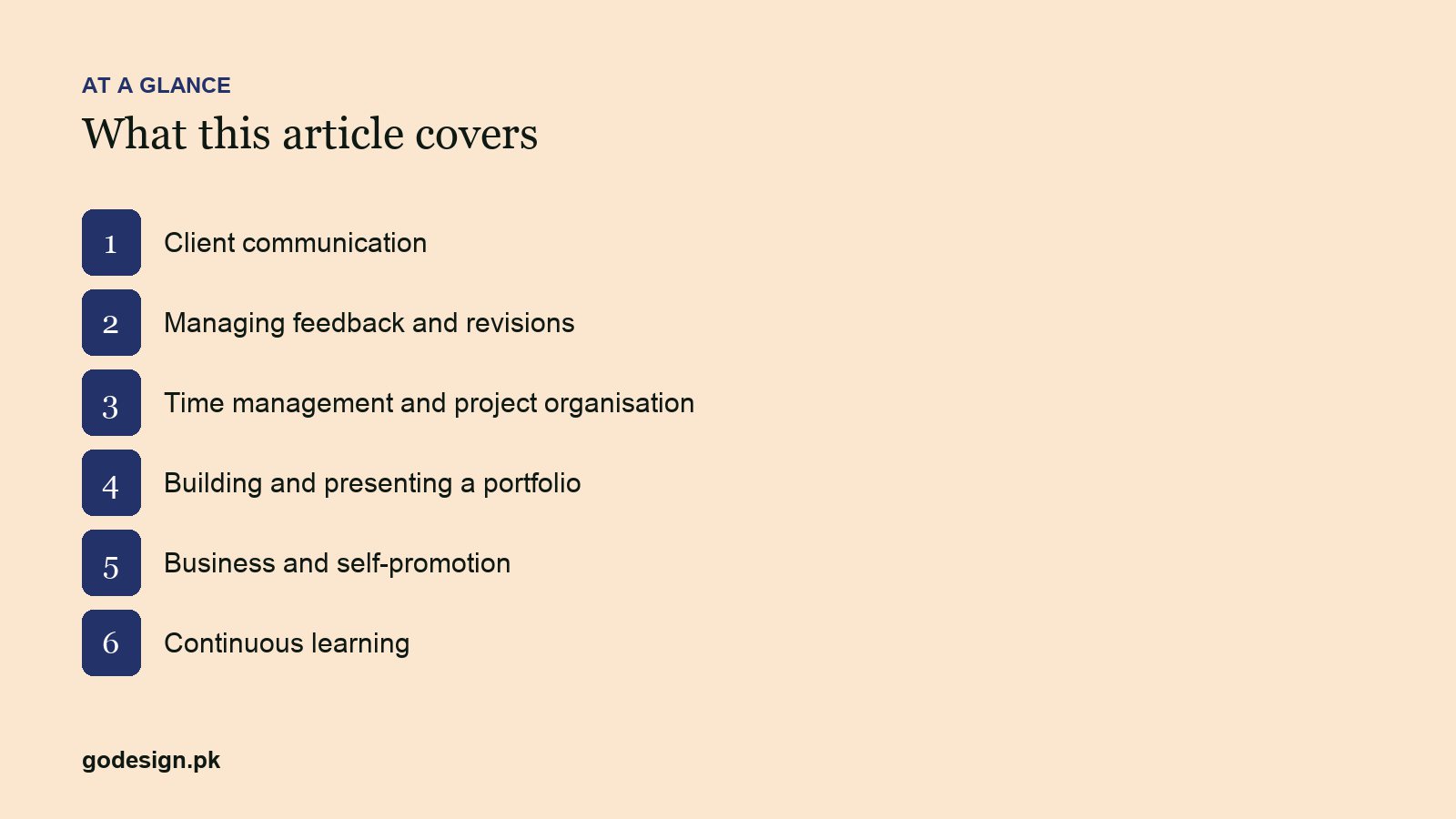
2. Managing feedback and revisions
Separating the client's problem ("it feels cold") from their proposed solution ("make it red"), and solving the problem. Presenting two or three considered directions rather than twenty. Agreeing revision rounds up front so feedback has structure. Not taking it personally, and not caving on decisions that matter.
3. Time management and project organisation
Estimating honestly, breaking work into tasks, hitting internal deadlines so the project manager is never surprised. Files named and organised so a colleague can pick up the project. The working routine and time management pieces cover the mechanics.
4. Building and presenting a portfolio
Choosing the right pieces, writing the case study, and talking a client or interviewer through the decisions. Presenting is a skill: lead with the problem, show the solution, explain the choices, invite questions. See building a portfolio that wins clients.
5. Business and self-promotion
Understanding what the client's business needs the design to do, pricing work properly, and being visible: a current profile, a specialism, a network. Even in-house designers benefit; they are the ones who get promoted.
6. Continuous learning
Tools change yearly; principles do not. A great designer learns the new tool quickly because they understand the principle underneath, and keeps studying good work outside their field. Thirty minutes a day is enough. The design YouTube channels and creativity exercises are places to start.
| Skill | How to practise it |
|---|---|
| Communication | Write the brief back to the client in your own words before starting |
| Feedback | Ask "what problem does this change solve?" before acting on any note |
| Time | Estimate every task, then compare with actual for a month |
| Presenting | Present every project to a colleague before the client sees it |
| Business | Learn one client's business model per project |
| Learning | One principle, one tool feature, one piece of great work per week |
Common questions
- What is the most important skill for a graphic designer?
- Communication. A designer who understands the client's need and can explain their solution will produce better work and get rehired, regardless of software mastery.
- How do I handle a client who wants bad changes?
- Ask what problem the change solves, then propose a solution that addresses it without breaking the design. Explain the trade-off once, clearly. If they insist, do it; it is their brand and your job to advise, not to win.
- Do graphic designers need business skills?
- Yes, whether freelance or employed. Understanding how design affects sales, pricing your work and being visible are what turn a competent designer into a valued one.