1. Understand white space
Empty space is not wasted; it is what lets the eye find the content. Beginners fill every gap. Professionals leave room. If a layout feels cluttered, remove elements before shrinking them.
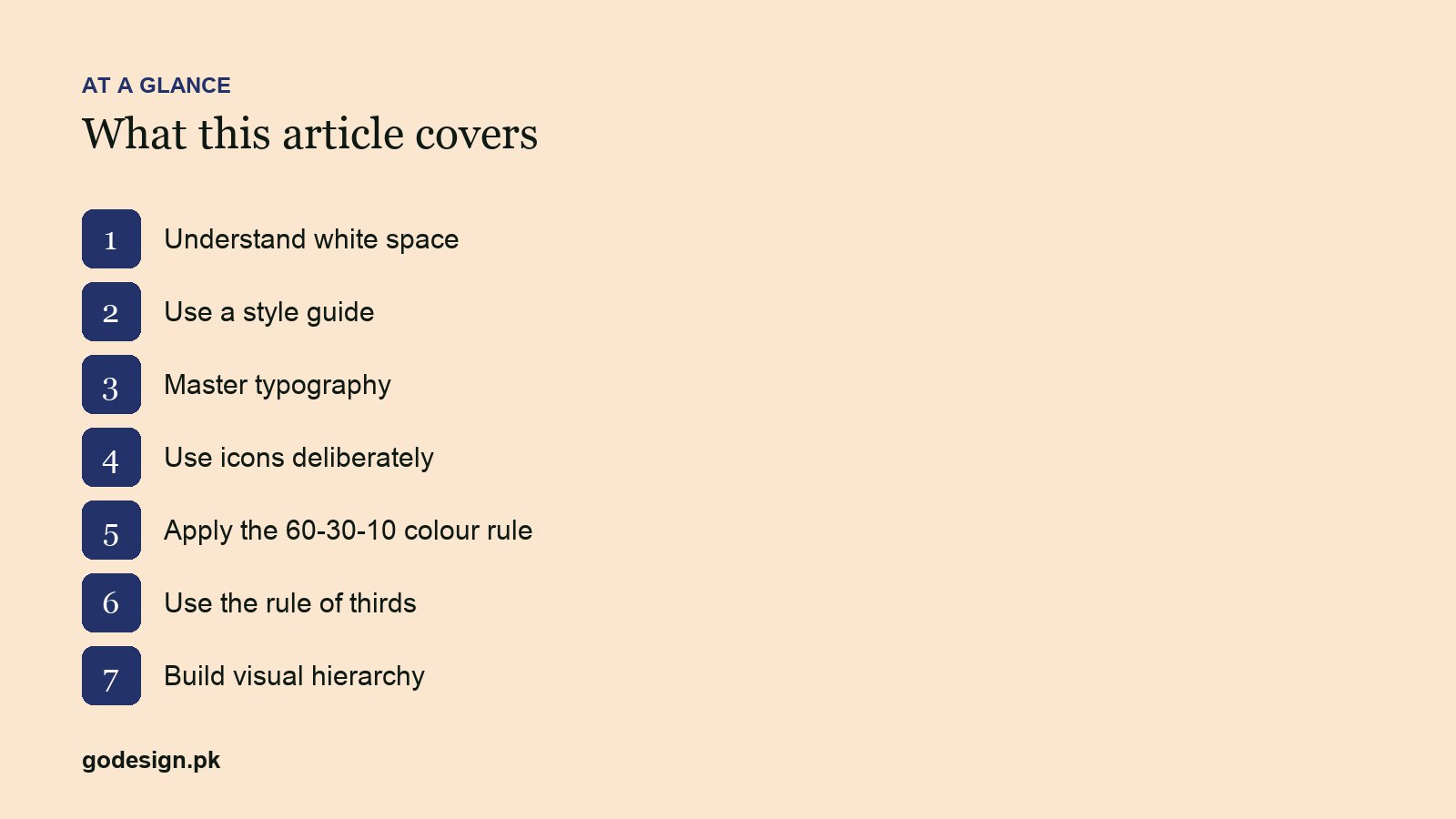
2. Use a style guide
Colours, fonts, sizes and spacing decided once and reused. Consistency is what makes work look professional, and a guide is how consistency survives a second designer. Even a one-page guide helps; see social media design guidelines.
3. Master typography
Two typefaces at most, a clear size scale, line lengths of 45 to 75 characters, generous line height, and kerning fixed by hand in headlines. Most amateur work is identifiable by its type before anything else.
4. Use icons deliberately
Icons speed recognition when they are consistent and labelled, and add noise when they are decorative. One set, one weight, one size scale. The free icon sources piece lists good ones.
5. Apply the 60-30-10 colour rule
Sixty percent dominant colour (usually neutral), thirty percent secondary, ten percent accent for the elements that matter. It stops palettes fighting and keeps calls to action visible.
6. Use the rule of thirds
Divide the canvas into a three-by-three grid and place focal points on the lines and intersections rather than dead centre. Layouts and photos feel more dynamic without any extra elements.
7. Build visual hierarchy
The eye should know where to look first, second and third. Size, weight, colour and position create that order. If everything is big and bold, nothing is.
8. Design for the audience, not for yourself
A pension fund's customers and a sneaker brand's customers want different things from a page. Ask who will see the work and what they need to do, then design for that. Portfolio-driven design is the most common beginner failure.
9. Learn the software properly
Shortcuts, styles, components, export settings. Fluency frees attention for design decisions. Spend a week on fundamentals of Figma or Illustrator rather than a month of trial and error; the design software guide covers which tool for which job.
10. Study good design
Collect work you admire and write down why it works: the grid, the type, the spacing. Copy it as an exercise, never as a deliverable. Taste is trained by attention.
Common questions
- What is the most important graphic design principle?
- Hierarchy. If the viewer knows where to look first, most other problems are forgivable; if they do not, nothing else helps.
- Which software should a beginner graphic designer learn first?
- Figma for anything digital and Adobe Illustrator for logos and print. Photoshop when you work with photographs. Canva is fine for quick social content but limits growth.
- How long does it take to learn graphic design?
- Software basics in a few weeks; competent, consistent work in six to twelve months of daily practice with feedback; genuine judgement over years. The principles above shorten the middle stage.