What does it mean to brand yourself as a designer?
It means deciding, in one sentence, what kind of design work you want to be known for and for whom, and then making every place a client meets you say the same thing. "Graphic designer" is a job title. "Brand identities for restaurants and cafés" or "app interfaces for fintech startups" is a position, and a position is what a personal brand is built on.
This guide is about positioning yourself as a designer specifically: the portfolio, the profiles, the proposals and the niche. For personal branding in general, including the PIE model and building an audience online, see our guide to building a personal brand.
Why designers need a personal brand
- Clients hiring a designer are buying taste and judgement they cannot fully check in advance. A clear brand reduces that risk for them.
- On marketplaces and social platforms you are shown beside many other designers. A specific position is what makes a client stop on your profile.
- Referrals get more accurate. Past clients can only recommend you for the right work if they know what that work is.
- You can charge more when you are compared with a few specialists rather than with every generalist on the platform.
- Your own brand is a live sample of your work. A designer with an inconsistent profile is a hard sell for a branding job.
How to brand yourself as a designer in 5 steps
Each step ends with something you can write down or publish. Do them in order; the later steps depend on the earlier answers.
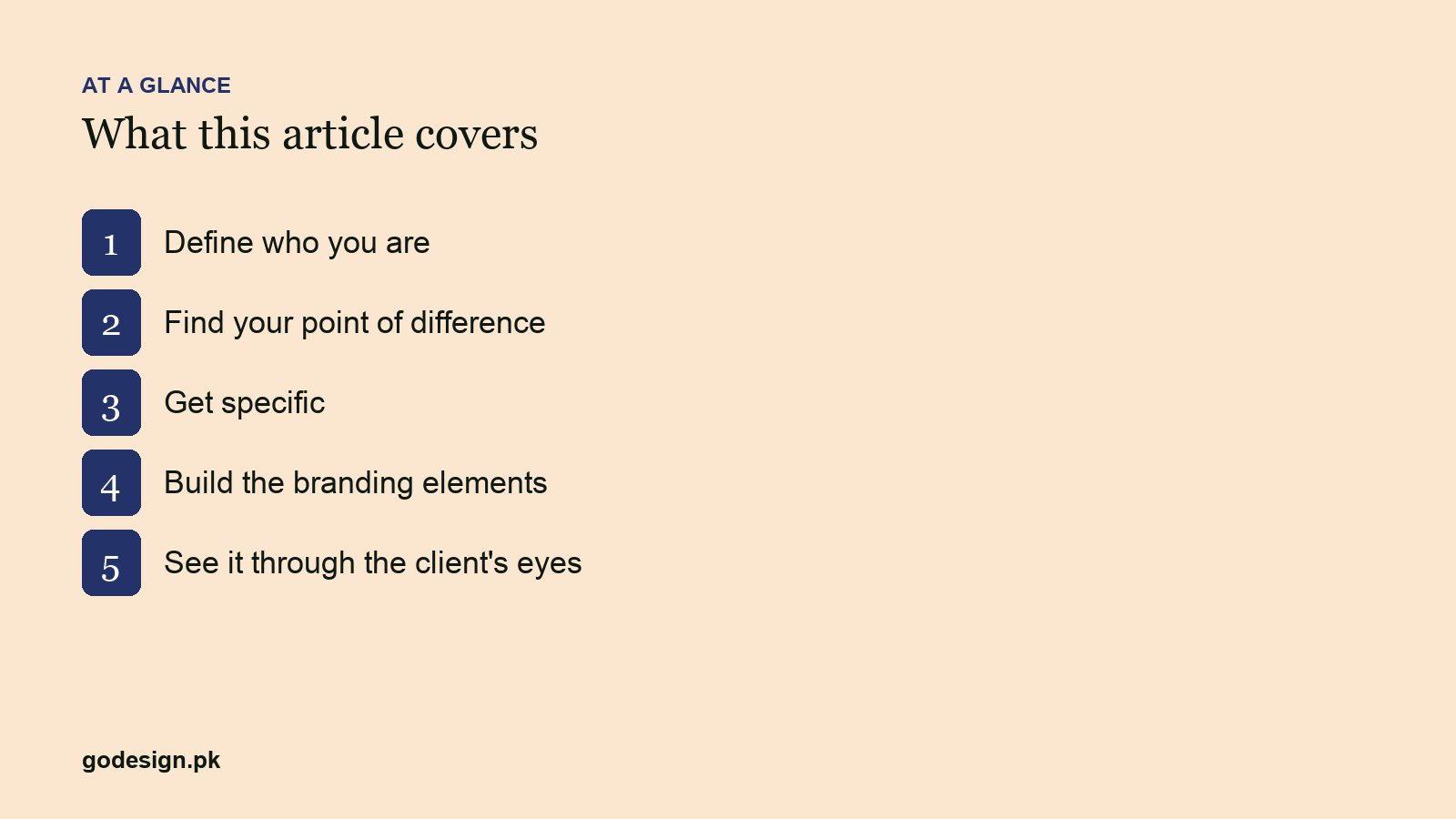
1. Define who you are
Write three lists: the design work you are best at, the work you enjoy, and the work clients have actually paid you for. Where the three overlap is your territory. A designer who is strong at typography, enjoys packaging and has been paid for food labels has a brand waiting to be named. If the lists do not overlap yet, the third list tells you what the market already trusts you with.
Output: the overlap in one sentence, for example "packaging and labels for small food brands".
2. Find your point of difference
Look at ten designers who do similar work and note what they all say. Then list what you can honestly claim that most of them cannot: an industry you know from the inside, a language, a process, a turnaround, a style, a time zone that suits a particular market. The difference does not need to be unique in the world. It needs to be clear and true in the market you are selling to.
Output: a sentence in the form "Unlike most [designers like me], I [difference]".
3. Get specific about who you serve
Generic positioning attracts generic briefs and price comparisons. Narrow by service (logos, packaging, UI, social media), by client type (restaurants, clinics, SaaS, schools) or by market (local businesses, clients in the UK or Gulf). You can still accept other projects; you just market the specific one. Our guide to finding a niche in design walks through how to choose and test one.
Output: a headline for your website, LinkedIn and freelance profiles.
4. Build your own brand identity
Give your own brand the care you give clients: a name (your own or a studio name), a simple wordmark or monogram, one or two colours, a type pairing, a consistent profile photo and a tone of voice. Keep it restrained so the work stays the focus. Then apply it everywhere: your personal website, Behance, LinkedIn, freelance profiles, proposals, invoices and email signature.
Output: a one-page personal brand guide, and every profile updated to match it.
5. See yourself through the client's eyes
Search your own name. Open your website on a phone with mobile data. Read your Upwork or Freelancer.com profile as a founder with a deadline and ten other tabs open. Within a minute, can they tell what you do, for whom, whether you are good and how to hire you? Then ask two past clients what they would say you do. If their answer differs from your headline, one of them needs to change.
Output: a short list of fixes, done this week.
Where to show your designer brand
| Channel | What it is for | What to put there |
|---|---|---|
| Your own portfolio website | Where enquiries should land; the only channel you control | Three to six case studies in your niche, your positioning headline, a contact form |
| Behance | Searchable, detailed case studies | Full project write-ups with process, not only final images |
| Dribbble | UI and visual design shots; some client briefs | Focused shots of interface and visual work |
| Being found by business owners and agencies | Headline that states your niche, posts about your process and results | |
| Visual audience and local clients | Consistent grid, short process clips, clear bio with your niche | |
| Freelance marketplaces | Buyers who are ready to hire now | Profile headline and portfolio items that match your niche exactly |
You do not need all of them. Pick the two where your clients actually look, plus your own site. We compare the options in how portfolios help designers find clients, and good mockups make every channel look more professional; see our list of mockup websites for designers.
How to become a brand designer
If the niche you want is brand design itself, the five steps still apply, with one extra demand: your own brand becomes your main sample. A brand designer creates the visual identity of a business, usually the logo, colour palette, typography, imagery style and the guidelines that keep them consistent. Clients expect to see that thinking in your portfolio, not only finished logos.
- 01Learn the fundamentals properly: typography, colour, layout and vector drawing in a tool such as Adobe Illustrator or Affinity.
- 02Study how identities are built, not just logos: research, positioning, systems, guidelines and applications.
- 03Build three to five complete identity projects. Self-initiated or rebrand concepts for real local businesses are fine if you label them honestly.
- 04Write each project up as a case study: the problem, the research, the options you rejected and why, the final system on real mockups.
- 05Get the first paid projects through freelance marketplaces, contests, referrals or a junior role at a studio, then raise your rates as your case studies improve.
Our posts on what a good brand logo needs and how to design a unique logo cover the logo side of the craft in more detail.
Designer positioning statement examples
A good statement names the work, the client and the reason to choose you. Use these as patterns, not copy:
- "Packaging and labels for small food and drink brands, from first sketch to print-ready files."
- "Brand identities for clinics and healthcare startups that need to look trustworthy on day one."
- "UI design for fintech apps, with design systems your developers can actually build."
- "Social media templates for restaurants, built in Canva so your team can post without a designer."
- "Urdu and English bilingual branding for businesses selling across Pakistan."
Personal branding mistakes designers make
- Showing everything. Twenty unrelated pieces say "generalist"; six focused ones say "specialist".
- A clever studio name that hides what you do. If the name is abstract, the headline has to be very clear.
- Over-designing your own identity until it competes with the portfolio.
- A different story on every profile: one headline on LinkedIn, another on Behance, a third on Fiverr.
- Changing niche every few months. Positioning compounds only if you hold it long enough for people to remember it.
- Showing only final images. Clients hire your thinking, so show the process.
Common questions
- How do I brand myself as a graphic designer?
- Decide what work you are best at and for which clients, find what sets you apart from designers doing similar work, and write that as one headline. Then design a simple identity for yourself and use the same headline, look and portfolio focus on your website and every profile.
- Should I use my own name or a studio name?
- Use your own name if you plan to stay solo and want personal recognition, and a studio name if you may hire people or sell the business one day. Many designers combine the two: a studio brand with a clearly visible founder.
- Does specialising lose me work?
- It loses generic work you were unlikely to win anyway and tends to win more relevant work at better rates. You can still accept outside projects quietly while marketing the specialism.
- What does a brand designer do?
- A brand designer creates the visual identity of a business: the logo, colour palette, typography, imagery style and the guidelines that keep them consistent. The job starts with research into the business and its competitors, not with drawing.
- How do I become a brand designer?
- Learn typography, colour and vector drawing, then build three to five complete identity projects and write each up as a case study showing your research and process. Use those to win first projects through marketplaces, referrals or a junior studio role.
- How long until personal branding brings clients?
- Expect months rather than weeks. Positioning works through repetition, so the designers who see results are usually those who keep the same niche, headline and portfolio focus long enough for clients and referrers to remember them.