How much should you budget for graphic design?
There is no honest single figure, because "graphic design" covers everything from a resized social post to a full brand identity. A better question is what the design has to do. Ask how many places it will appear, how long it will stay in use and what it costs you if it is mediocre. Spend in proportion to those answers.
Design budgets go wrong in two directions. Spend too little on something permanent and you pay again within a year to redo it. Spend too much on something temporary and you buy polish nobody notices. The rest of this guide helps you land in between, and gives you a way to sanity-check any quote.
What drives the cost of graphic design?
Two quotes for "a logo" or "a brochure" can differ tenfold and both be fair, because they are pricing different amounts of work. These are the factors that move the number:
| Cost driver | Why it changes the price |
|---|---|
| Research and strategy | Studying your customers and competitors before designing takes time, and it is what separates a brand from a picture |
| Number of concepts | Three genuinely different directions cost more than one idea with variations |
| Revision rounds | Each agreed round is more hours; unlimited revisions are priced in somewhere |
| Number of formats and sizes | One design adapted for print, web, social and signage is several jobs |
| Files and handover | Vector source files, colour versions and guidelines take time to prepare properly |
| Rights and usage | A full copyright transfer, or broad commercial use, is worth more than limited use |
| Copy, photography and illustration | Writing, photo shoots and custom illustration are separate skills, often separate costs |
| Designer's experience and location | Senior designers and studios in high-cost cities charge more per hour |
| Deadline | Rush work displaces other clients, so it usually costs extra |
How to set a design budget from the job
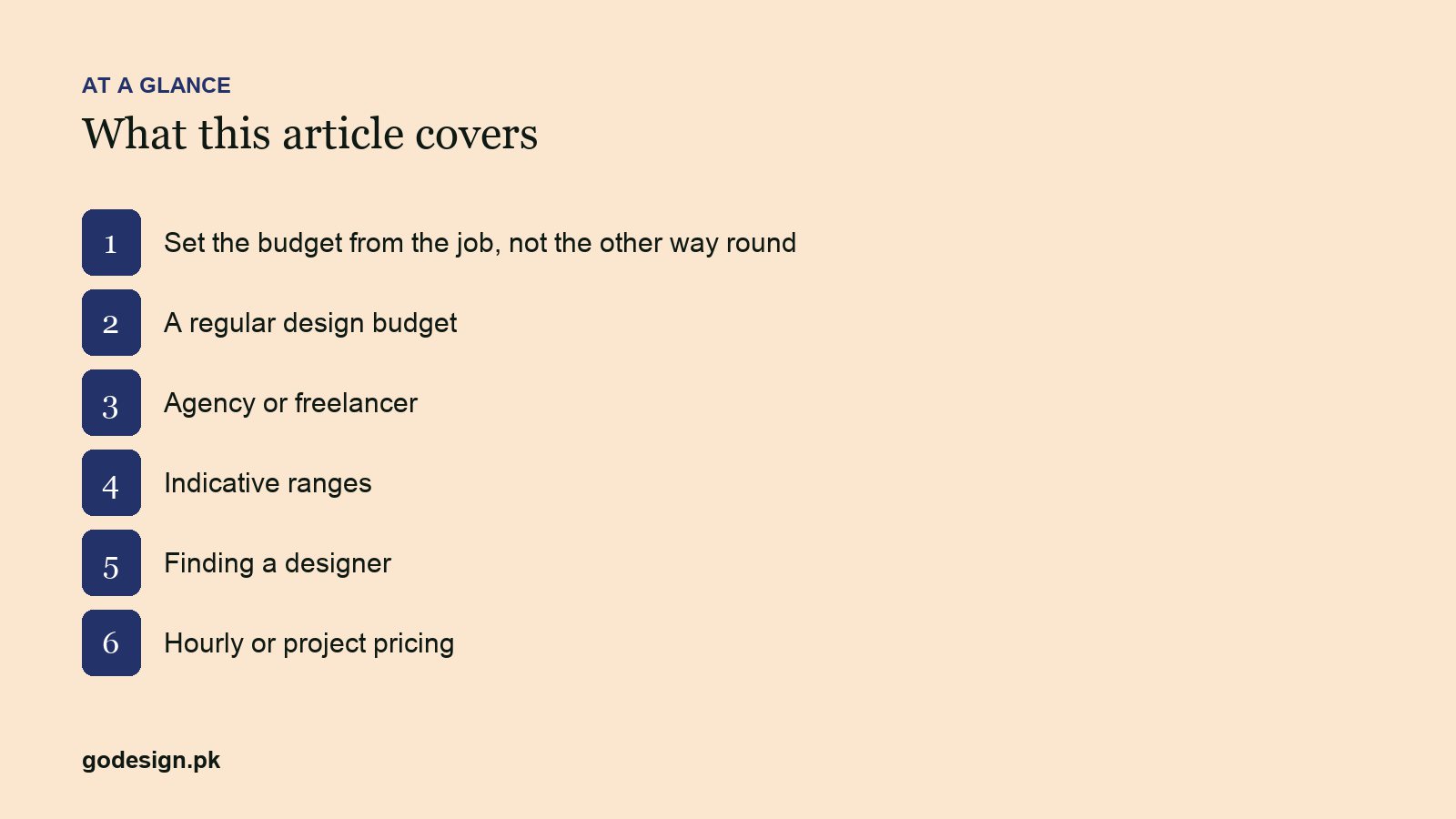
- 01List the pieces you need this year: logo or refresh, website design, packaging, social templates, brochures, ads, presentations.
- 02Mark each one as permanent (used for years), recurring (needed every month) or temporary (one campaign).
- 03Put most of the budget into permanent pieces, because their cost is spread over every use.
- 04Set a monthly amount for recurring pieces rather than paying for each one separately.
- 05Keep temporary pieces cheap and fast, ideally built from templates your designer made once.
- 06Ask two or three designers to quote the same written brief, then compare what each quote includes, not only the total.
One more question helps with the total: what is a new customer worth to you? If a better brochure or website brings even a few extra customers a year, the budget that makes sense is usually higher than the one that feels comfortable.
What does a logo cost?
Logos are the most common design purchase, and our logo design price guide sets out indicative ranges from quotes seen in 2025 and 2026. They are not a survey, and they move with scope, but they are a useful benchmark:
| Who designs it | Indicative price (from our logo price guide) |
|---|---|
| Logo maker or AI generator | Free to about $100 |
| Entry-level freelancer | $50 to $300 |
| Experienced freelancer | $300 to $2,500 |
| Design contest | $300 to $1,500 |
| Agency or brand studio | $2,500 and up |
| Freelancer in Pakistan | PKR 10,000 to 60,000 |
| Agency in Pakistan | From around PKR 80,000, past PKR 300,000 for a full identity |
Other deliverables follow the same logic. A full brand identity costs more than a logo because it adds colour and type systems, stationery and guidelines. A company profile or pitch deck is priced mainly by page count, how much copy and data the designer has to shape, and whether charts and illustrations are custom. Ask for those factors in every quote.
One-off projects or a monthly design budget?
Businesses that market all year need design all year: social posts, ads, email headers, sales decks, event material. Paying for each piece separately is slow and usually costs more per piece. A monthly retainer with a freelancer or agency gives you a fixed number of hours or pieces each month, faster turnaround and a designer who already knows your brand.
An in-house designer makes sense once you have enough steady work to fill their week, plus someone who can direct them. Until then, a retainer gives you the consistency of a dedicated designer without a salary, equipment and software licences. Many businesses use both: an agency for brand and website work, an in-house or retained designer for day-to-day content.
Freelancer or agency: which fits your budget?
| Freelancer | Agency | |
|---|---|---|
| Cost | Lower rate, little overhead | Higher rate, includes management, review and cover |
| Best for | Defined pieces and ongoing content | Brand systems, websites, campaigns across many formats |
| Main risk | Depends on one person's availability and skills | Overhead that is not worth it on small jobs |
Scope decides more than budget. A freelancer is usually the better value for a single defined piece; an agency is often better value for a brand or website that needs several skills coordinated. Our freelancer versus agency comparison goes through the trade-offs in detail, and how to hire a graphic designer covers the brief, the portfolio check and the red flags.
Hourly or project pricing?
Choose project pricing for anything with a clear finish: a logo, a brochure, a pitch deck, a packaging design. You know the cost up front, and the designer carries the risk if it takes longer. Choose hourly or a retainer for ongoing or undefined work, such as content, small edits and support.
Avoid open-ended hourly billing for creative work with a fuzzy scope. It rewards slowness, makes the final bill unpredictable and leads to arguments about what was included. If a designer only works hourly, ask for an estimate with a cap.
How to get design quotes you can compare
Most quote confusion comes from a vague brief. Send every designer the same one, covering:
- What your business does, who your customers are and who your competitors are.
- Exactly which pieces you need, in which sizes and formats, and where they will be used.
- Whether you have a logo, colours and fonts already, and whether they can change.
- Who provides the copy and photos.
- Your deadline, and whether it is fixed.
- That you want the number of concepts, revision rounds, files delivered and rights transfer stated in the quote.
Then compare like with like. A cheaper quote with one concept, one revision round and no source files is not cheaper for the same work.
Where to save, and where not to
- Do not save on anything permanent and widely reproduced: your logo, brand identity, packaging and website design.
- Do save on temporary pieces by asking for reusable templates you can edit yourself in Canva or similar tools.
- Do bundle related work, such as a logo and business cards, into one brief rather than separate jobs.
- Do give clear, consolidated feedback in each round; scattered feedback creates extra revisions you pay for.
- Do not pay for unlimited revisions. Two or three well-managed rounds produce better work.
How AI changes design budgets in 2026
Production work has become cheaper. Resizing, background removal, template variations and quick mockups now take minutes with AI tools, and it is reasonable to expect quotes for that kind of work to reflect it. Strategy, identity and original concept work have not become cheaper, because the hard part was always the thinking. Be wary of anyone pricing a brand identity as if it were production, and ask any designer who uses AI-generated elements to confirm you can use them commercially.
For website budgets in particular, the design and build are only part of the cost. The guide to why the build is the smallest part of what a website costs on our sister site godesigntech.com covers hosting, content and upkeep.
Sources
- Logo price ranges are taken from GoDesign's logo design price guide (godesign.pk/3-amazing-logo-design-cost-estimates-2022/), where they are indicative ranges from quotes seen in 2025 and 2026, not a survey.
Common questions
- How much should a small business spend on graphic design?
- There is no reliable rule that fits every business. List the pieces you need this year, put most of the budget into permanent ones such as your logo, packaging and website, and set a monthly amount for recurring content like social posts and ads.
- How much does a logo cost in Pakistan?
- Our logo price guide gives indicative ranges of PKR 10,000 to 60,000 for a freelancer with source files, and from around PKR 80,000 to past PKR 300,000 for an agency when a full brand identity is included. The number of concepts, revisions, files and rights decides where a quote falls.
- Why do agencies charge more than freelancers?
- An agency rate covers a team, project management, quality review, cover when someone is away and a company accountable for the result. On small pieces that overhead is rarely worth it; on a brand identity or website it often is.
- Should I pay a designer hourly or per project?
- Pay per project for work with a clear end, such as a logo, brochure or pitch deck, so you know the cost in advance. Use hourly rates or a monthly retainer for ongoing work, and ask for a capped estimate if a designer only bills by the hour.
- What should a graphic design quote include?
- The deliverables and formats, the number of initial concepts, the number of revision rounds, the files you will receive, who owns the rights, the timeline and what costs extra. Without those details, two quotes cannot be fairly compared.
- Is cheap design a false economy?
- Often, for anything permanent. A weak logo or website costs you every time it is seen, and redoing it costs more than doing it properly once. For temporary work, such as a one-off event post, cheap and fast is usually the right call.
- How can I reduce design costs without lowering quality?
- Write a clear brief, bundle related pieces into one project, give consolidated feedback in each round and ask for editable templates for repeat work. Those steps cut wasted hours without cutting the thinking that makes design work.