1. You control the image
On a platform your work sits in someone else's template, next to competitors, ranked by an algorithm. On your site you decide what appears first, how it is described and what the visitor sees next. That control is the difference between being one of a thousand designers and being the one they remember.
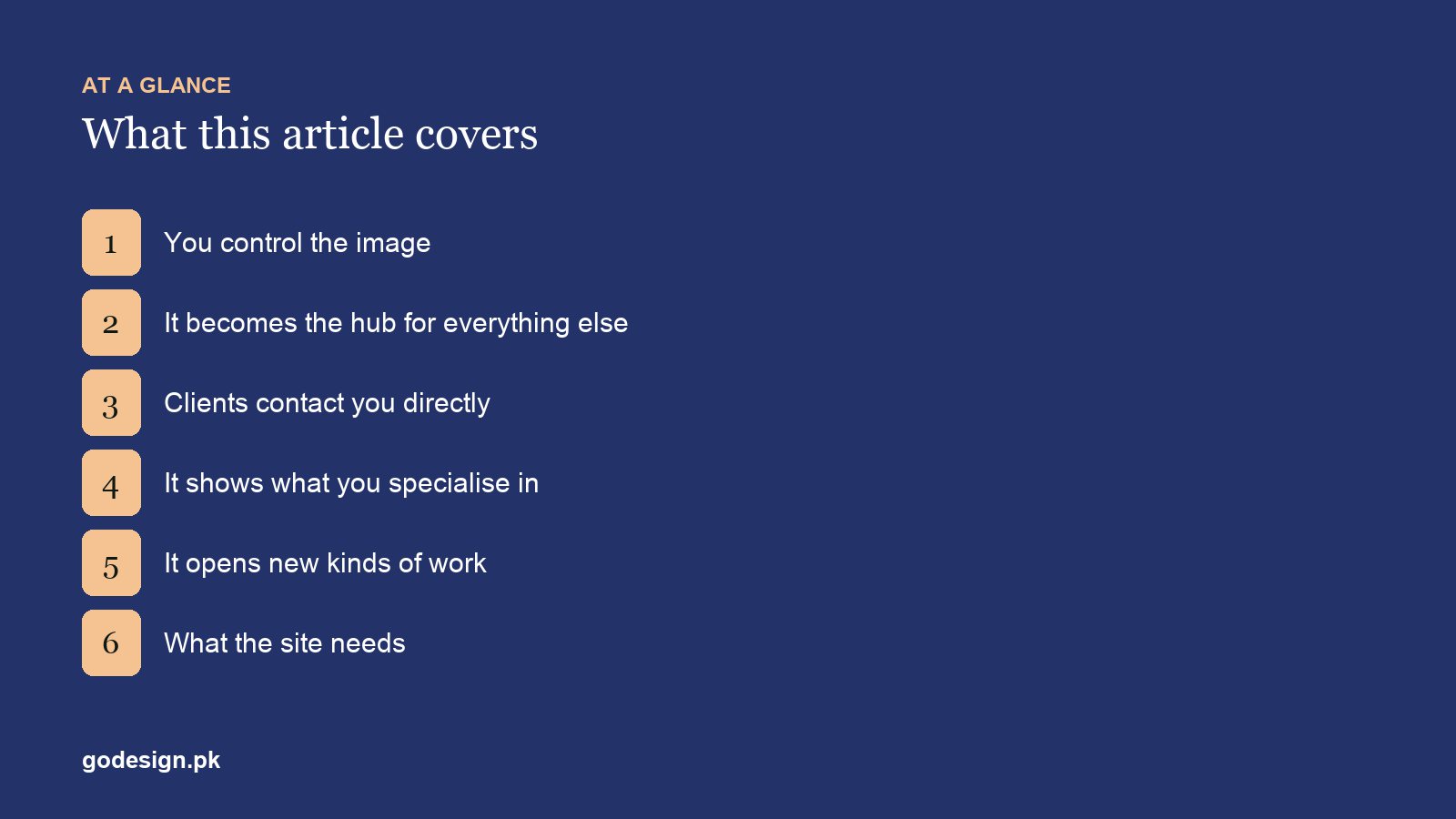
2. It becomes the hub for everything else
Every profile links here. Every post links here. Clients who find you on Instagram land on a page with your work, your process and a form. Traffic that platforms would keep becomes yours to track and convert.
3. Clients contact you directly
No platform fee, no message inbox you forget to check, no rules about taking work off-site. A contact form that lands in your email or CRM, with the questions you need answered, is the shortest path from interest to a project.
4. It shows what you specialise in
A site can say "I design ecommerce brands for skincare companies" on the first screen and prove it with three case studies. A profile grid cannot. Specialism is what lets clients refer you and search engines rank you; see finding a niche.
5. It opens new kinds of work
A blog on your site ranks for the questions your clients ask, which brings clients who never visit design platforms. It also makes you visible to agencies looking for partners, which is how many of our own collaborations started. The dedicated team service exists because freelancers with good sites got found.
What the site needs
- One line on the first screen: who you help and with what.
- Six to ten case studies with a paragraph each on brief, approach and result.
- A short about page with a real photo.
- A contact form and your email, plus WhatsApp if clients use it.
- Fast, mobile-first, on a domain you own. WordPress or a builder is fine; see portfolio builders.
Common questions
- Is a personal website still necessary with LinkedIn and Behance?
- Yes. Platforms change their reach and rules without warning and take a cut of on-platform work. The website is the only channel you control and the only one that ranks in Google for your specialism.
- How much does a personal website cost?
- A domain and hosting from a few dollars a month on a builder or WordPress, plus your time. A professionally built site with case studies and lead capture is a few hundred to a few thousand dollars depending on scope.
- What should be on a designer's homepage?
- A one-line positioning statement, three to four strongest projects, one or two client quotes, and a clear route to contact. Everything else belongs on inner pages.