
1. Find your why
Write one sentence: who you help, with what, and why it matters to you. For a freelancer this is the positioning that filters enquiries. For a founder it is the reason the company exists beyond revenue. Everything else in the framework refers back to this sentence. Output: the sentence, pinned above your desk.
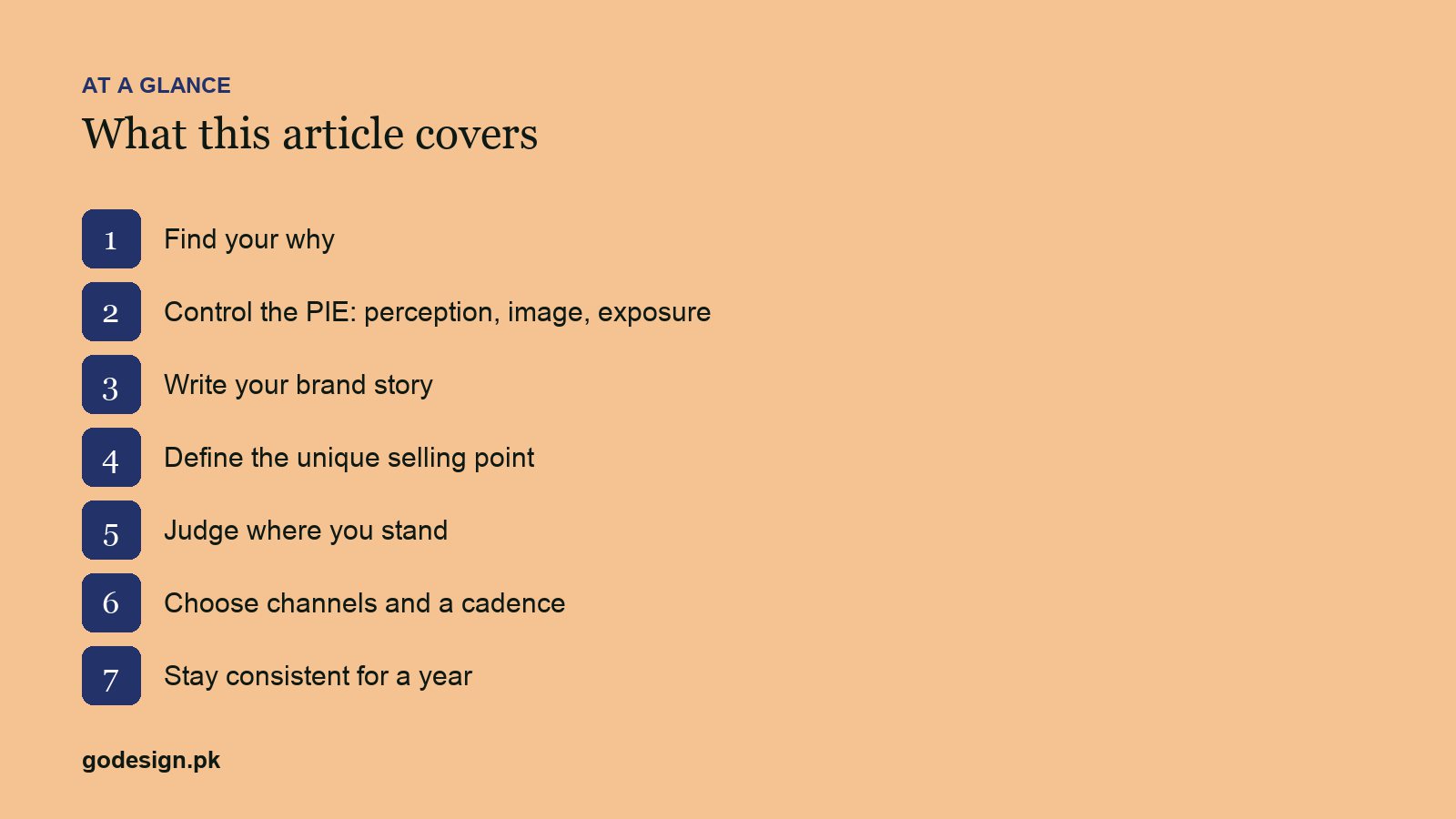
2. Control the PIE: perception, image, exposure
Perception is what people think you are good at. Image is how you present: photo, profile copy, tone. Exposure is where you appear and how often. Most people work only on image. Perception comes from proof (work, results, reviews) and exposure comes from showing up in the right rooms. Output: an audit of all three, with one improvement each.
3. Write your brand story
Four parts: the purpose (why you do this), the core values (how you work), the benefits (what clients get) and the tangible elements (name, photo, colours, tone). A page at most. Output: a brand story document you can paste into any profile.
4. Define the unique selling point
What you do that the next ten people with your job title do not. Specialism is the usual answer: an industry, a platform, a type of client. "WordPress developer" is a crowd; "WooCommerce developer for European food brands" is a name. See finding a niche. Output: one line, used in every headline.
5. Judge where you stand
Search your name. Read your profiles as a stranger. Ask three clients what they would say about you. The gap between what you found and what step three says is the work. Output: a short list of gaps.
6. Choose channels and a cadence
One primary channel where your clients are (LinkedIn for most B2B, Instagram for consumer creative work), a personal website as the home base, and a realistic rhythm: one substantial post a week beats daily noise. Output: a calendar you will actually keep.
7. Stay consistent for a year
Personal brands compound slowly. Same message, same face, same tone, across every touchpoint, for long enough that people start to associate the two. Review quarterly; change tactics, not the story. Output: a quarterly review date in the calendar.
Common questions
- Do I need a personal brand if I work for an agency?
- It helps. Agency clients often choose the agency because of a person they trust, and a visible professional profile raises your value inside and outside the company.
- How long does it take to build a personal brand?
- Visible results in six to twelve months of consistent output; a reputation that brings clients unprompted usually takes longer. The compounding is the point.
- Is a personal website necessary?
- It is the only channel you own. Social profiles change their rules and reach; a simple website with your story, work and contact details does not.